Real-world simulation brings nursing and interpreter education students together
Mar 27, 2026



Mar 27, 2026
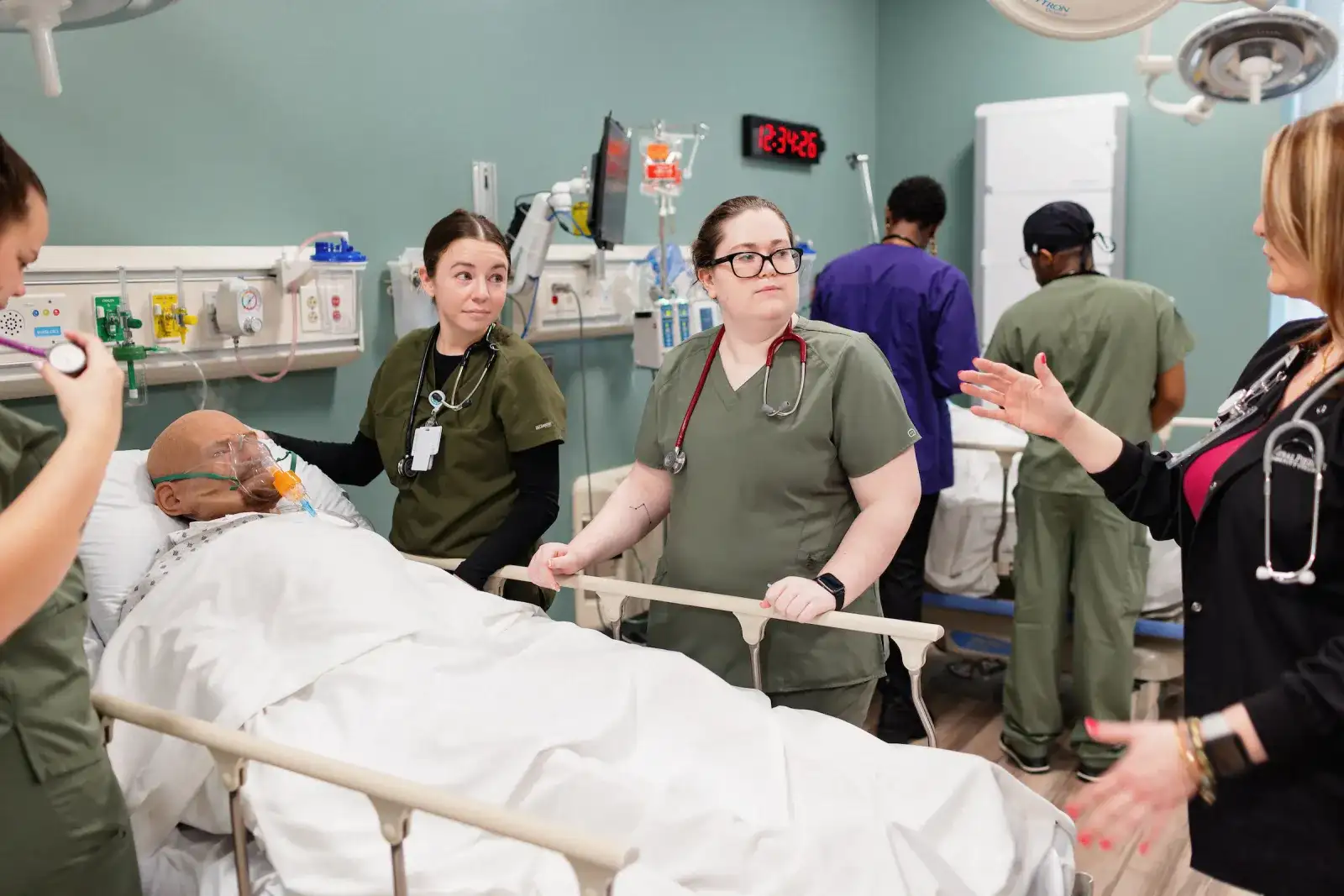
A collaboration that had been in the works for months recently came to fruition. At the Central Piedmont Community College Simulation Center, the college’s Nursing program collaborated for two days with the Interpreter Education program to run a stroke scenario.
But not only was the patient having a stroke, they were also users of American Sign Language and utilized interpreting services to access communication.
The collaboration was the brainchild of Kate Durkee, Central Piedmont interpreter education instructor.
“In our field of interpreting, it has been found that we often don't get enough practice in real-life situations,” Durkee said. “Because of the accessibility of video recordings and being able to practice in front of a screen, there's been a lot of skills practice and drilling in that 2D format. But it strips away the opportunity to work with real people who are going to move and react and respond in different ways. Research shows that even if student interpreters do not have the skills yet to interpret in a medical facility, the experience of trying is really helpful and can really grow their skills.”
Durkee reached out to Laura Cragg, director of the simulation center, who in turn put out a call to department chairs in health sciences. Christi Champion, department chair of the LPN (Licensed Practical Nurse) to ADN (Associate Degree in Nursing) Bridge program, thought it would be an ideal opportunity for her students. Those individuals work in healthcare and are already licensed nurses. Now, they are taking another step to obtain an associate degree in nursing.
“I thought this was a great idea,” Champion said. “It is very realistic that anybody who walks into the hospital could have a Deaf patient or a hard-of-hearing patient. I felt that my students specifically have some more critical thinking skills than the other nursing students who are not licensed yet and do not have as much practice in the healthcare facility.”
Nursing students began the scenario with an assessment determining the patient is Deaf and having a stroke, while also recognizing the need to call an interpreter.
After a short time — to increase realism and real-life anxiety — interpreter students came into the room and interpreted for all parties, communicating with the nurses as they continued patient care.
Nursing students also learned about alternative communication techniques, such as communication boards, pointing, gesturing, writing, and showing before doing that they could use while awaiting interpreting services.
The participants who played the role of the patients are faculty for the ASL program and are themselves Deaf.
Katie Linker served as one of the patients.
“Everyone was learning so much from one another,” she said. “You could see the nursing students and the interpreting students really collaborating and talking through Deaf culture, communication access, nursing, and healthcare. Everyone left with something that they can utilize for next time.”
Cragg says that in the science of simulation, debriefing is the most important part.
“It’s where the education really happens,” she said. “I always say people do the right thing for the wrong reason, or they do the wrong things for the right reason. Maybe their thought process was great, but then they just made the wrong decision on how to act on it. We get that conversation going and also encourage them to discuss their emotions in this psychologically safe environment.”
The overwhelming takeaway was that students all wanted to advocate for the patient, but in this scenario, understanding how to do that and who to communicate with was the greater challenge.
In healthcare, the scenario simulated is known as a “low-volume, high-risk" situation. Because stroke care is extremely time-sensitive, any delay in communication can directly delay treatment. For Deaf patients, communication barriers can slow assessment, diagnosis, and decision-making, increasing the time to intervention. In stroke care, “time is brain,” meaning that every minute without treatment can result in additional loss of brain tissue.
Some interpreter students will go into the interpreting field of healthcare when they graduate. This experience gave them an opportunity to learn what it will be like in a real situation and see how different it is to interpret normal conversation from a medical conversation. The signs and terminology are different, and many patients have cognitive and/or physical deficits, which makes interpreting more difficult. This patient had right-sided weakness due to the stroke, making it hard to sign, and therefore harder for the interpreter students to understand what was being signed to them.
Medical interpreting is typically pursued as a specialization post-graduation for interpreting students, due to the intricacies and urgency required.
“Medical interpreting compared to conversational interpreting is a higher level,” Linker said. “There's more terminology because some of those medical words are quite complex.
"There are some terms that may not be fully understood by the patient, but the interpreter has to know and understand the meaning behind it or be able to request clarification. They must be able to accurately explain what the word means.”
Though their roles differ, interpreters and nurses are both patient advocates.
Champion saw both students and faculty learning together as they developed a deeper understanding of one another’s roles and strengths, and how they could support each other. To her, it was like light bulbs coming on.
“People were putting things together; things were making sense,” she said. “They had this critical thinking going on. That, to me, is an invaluable part of sim and any learning experience.”
By learning the perspective of a Deaf patient, the nursing students were able to better understand the importance of continuous communication. Keeping patients informed of their situation and care is critical as not all patients communicate the same way. The sim center also saw firsthand the value of communication, as the staff needed to utilize an alternative visual method to communicate with Linker and tell her when to progress her symptoms as she played a patient.
The goal is to continue the simulation with other programs, providing students with real-life training they can take into their careers in Mecklenburg County and beyond.