Interpreter Education student Victoria Burroughs works to bridge the gap in communication access
Mar 19, 2026


Mar 19, 2026
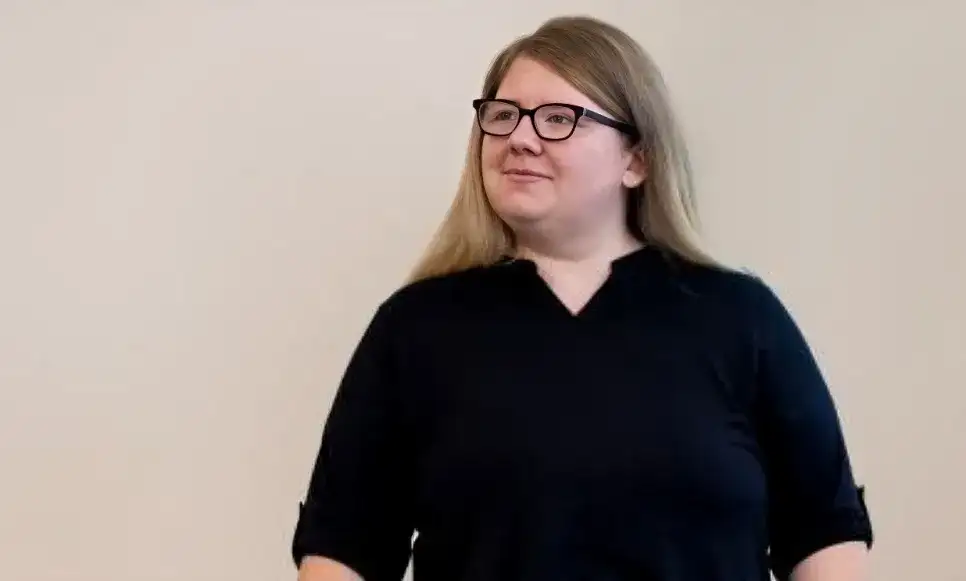
When Victoria Burroughs was growing up in Bristol, Connecticut, her church congregation included several Deaf and hard-of-hearing members. Ever since then, she has wanted to be an American Sign Language (ASL)-English interpreter.
She’s currently pursuing that dream as part of the Interpreter Education program at Central Piedmont Community College.
“I chose to study interpreting specifically because the Deaf community experiences a lack of communication access,” Victoria said. “Becoming an interpreter gives me the opportunity to be part of bridging that gap.”
A mother of three, Victoria lives in Monroe, N.C., having moved south from New England a decade ago. Her children played a significant role in her decision to return to college to pursue her associate degree in Interpreter Education.
“This is a passion and a dream of mine, so I really wanted to chase that and build a foundation for my future while making sure they have a good future, too,” she said.
Central Piedmont’s Interpreter Education program has a sterling reputation, which Victoria learned of before she started. She sees the passion for teaching in each faculty member and notes their eagerness to answer questions and offer advice or support. The program includes five full-time instructors — four Deaf and one hearing. In addition, there are two Deaf part-time faculty members.
“The Deaf community are obviously the experts in their own language and their own culture, so learning from them has been valuable for me,” Victoria said.
Victoria notes a common misconception about ASL is that it is a visual form of English, but it is actually a language of its own with its own grammar and sentence structure. Interpreters thus need to understand meaning and reformulate it into the other language. Plus, they need to be keenly aware of body language, tone, and expressions.
During the two-year associate degree program, students build a strong foundation in ASL and interpreting, continually learning and practicing, and ultimately complete an internship to work in the environment of an interpreter.
“You learn a new language, you learn a new culture, you're learning a new skill, and that's all happening in the classroom,” Victoria said of the program. “It is hands-on practice because ASL is a visual language. But you can’t just stick with what you’re learning in the classroom if you want to continue to grow your skills. Getting out and attending events, workshops, and networking with the Deaf community is all very important.”
Upon earning her Associate in Applied Science degree in May, and completing all necessary exams, Victoria will be licensed to work as an interpreter in North Carolina. Her goal is to become a community interpreter. These interpreters can work in a wide variety of locations but are often found in medical or educational settings.
With a national shortage of interpreters, Victoria encourages anyone interested to try it out.
Reflecting on her own journey, Victoria acknowledges she has devoted significant time and energy to her Interpreter Education studies. However, she is proud of what she has gained.
“Like the saying, nothing that is worth doing comes without sacrifice,” she said. “I can confidently say it’s worth it and I’m honored that I’m on my way to becoming part of that community.”